Questions and answers
Home and Business Security: 24 Questions People Actually Ask, Answered
By the Fogaway teamUpdated August 20269 min read
Security advice online tends to come in two flavours: vague reassurance or a sales pitch. This page is neither. It is a straight list of the questions homeowners and business owners actually ask us, answered the way we would answer a friend, in plain language.
Every answer below is short on purpose. Where a question deserves a full guide, we link to one: the fundamentals are in what a security fog system is, homes are covered in our home security guide, shops and offices in the business security guide, and the raid scenario in smash-and-grab prevention.
Use the questions below like an index. Tap any question to open its answer, and if yours is missing, ask us directly and we will add it to this page.
Frequently asked questions
What is the most effective way to protect a home from burglary?
Layers, not one gadget. Make entry slow with good locks and lighting, make detection certain with an alarm or sensors, and have a response that works in seconds. Most burglaries last under ten minutes, so anything that only alerts you after the fact protects your insurance claim, not your valuables.
Do burglar alarms actually deter burglars?
Partly. A visible alarm makes some burglars pick an easier target, but experienced ones know the average response time is far longer than the burglary. An alarm is essential as the detection layer, and it works best paired with something that physically stops the intruder, like security fog.
Are security cameras enough to stop a break-in?
No. Cameras record crime, they do not prevent it. Most intruders cover their faces and are gone in minutes, and footage of a hooded figure rarely leads to recovery of goods. Cameras are useful for evidence and remote checking, but they should never be the only measure protecting valuables.
What do burglars look for when choosing a house?
Signs of an easy, profitable, low-risk job: no visible alarm, weak door and window locks, cover from view, darkness, obvious absence of the owners, and valuables visible through windows. Removing even two or three of these signals moves most burglars on to another target.
How much should I spend on home security?
A sensible benchmark is one to three percent of the value you are protecting. A few hundred on locks and lighting, a few hundred on detection, and a few hundred on an active response layer typically outperforms one expensive gadget. Compare any budget against your insurance excess and the sentimental items no payout replaces.
Is a dog a good security measure?
A dog is a real deterrent for opportunists, and barking draws attention burglars hate. But a dog cannot stop a determined intruder, is not always home, and should never carry the whole plan. Treat a dog as a deterrent layer, not a response layer.
Do security lights and timers really work?
Yes, as deterrents. Motion-triggered lights remove the darkness burglars rely on, and timed interior lights make a home look occupied. They are among the cheapest measures with a measurable effect, and they make every other layer work better.
What should I do if I am home during a break-in?
Do not confront the intruder. Get everyone behind a lockable door, call the police, and make noise so the intruder knows the house is occupied. If you have a panic-triggered system such as security fog, activate it: it fills the space between you and the intruder with fog and usually ends the intrusion immediately.
What is the weakest point in most business security?
The gap between detection and response. Alarms and cameras tell you a break-in is happening, but in most areas nobody physically arrives for many minutes. A smash-and-grab needs ninety seconds. Whatever fills that gap, fog, shutters, or on-site response, matters more than any camera upgrade.
Which businesses are most at risk of burglary?
Businesses with compact, valuable, easy-to-sell stock: phone and vape shops, jewellers, pharmacies, opticians, computer stores and anywhere with cash on site. If your stock fits in a duffel bag and sells online in a day, plan for the raid scenario, not just shoplifting.
How do I protect my shop from smash-and-grab raids?
Slow the entry with laminated glass, shutters or bollards, then attack the raid's only asset: time inside. Security fog is the most direct tool, because it makes the stock impossible to find within seconds of the break-in. Keep the highest-value items in a time-delay safe overnight.
Should I keep cash on the premises overnight?
As little as possible, and never where it can be seen. Bank takings daily, use a bolted time-delay safe for the float, and put a sign in the window saying no cash is kept overnight. Cash is the one item every burglar can use, so reducing it reduces your attractiveness as a target.
What is a security closing-time routine?
A fixed checklist done in the same order every night: valuables into the safe or off display, cash banked or in the safe, doors and windows checked, alarm set, lights on timers. Most business break-ins exploit a single skipped step, and a routine makes skipping visible.
Will better security lower my insurance premium?
Often, yes. Insurers price risk, and documented measures such as certified locks, monitored alarms, safes and active systems like security fog can reduce premiums or unlock cover that is otherwise refused for high-risk trades. Always tell your insurer what you install and keep the paperwork.
Are insurance payouts enough, so I do not need prevention?
No. A payout arrives weeks later, after the excess, and covers the stock value, not the closed days, the broken customer trust, the staff who no longer feel safe, or anything sentimental. Prevention exists because most of what a burglary takes is not on the invoice.
What is security fog and how does it stop burglars?
A security fog device floods a room with dense, harmless fog within seconds of a break-in being detected. Visibility drops to almost nothing, so the intruder cannot find or grab anything and nearly always leaves immediately. It is one of the only measures that works during the burglary rather than after it.
Is security fog safe for people, pets and stock?
Yes. Quality security fog is made from food-grade fluid, is non-toxic, and leaves no residue on stock, furniture or electronics when the system is properly installed. It clears by itself after the event. Being inside it is disorienting only because you cannot see.
Does security fog trigger falsely?
Not on its own. Fog only fires when its trigger says so: a connected alarm, a sensor combination, a panic button, a remote or an app command. Configure it to require an armed system plus a detection event and accidental discharge becomes extremely unlikely.
Can I install a security fog system myself?
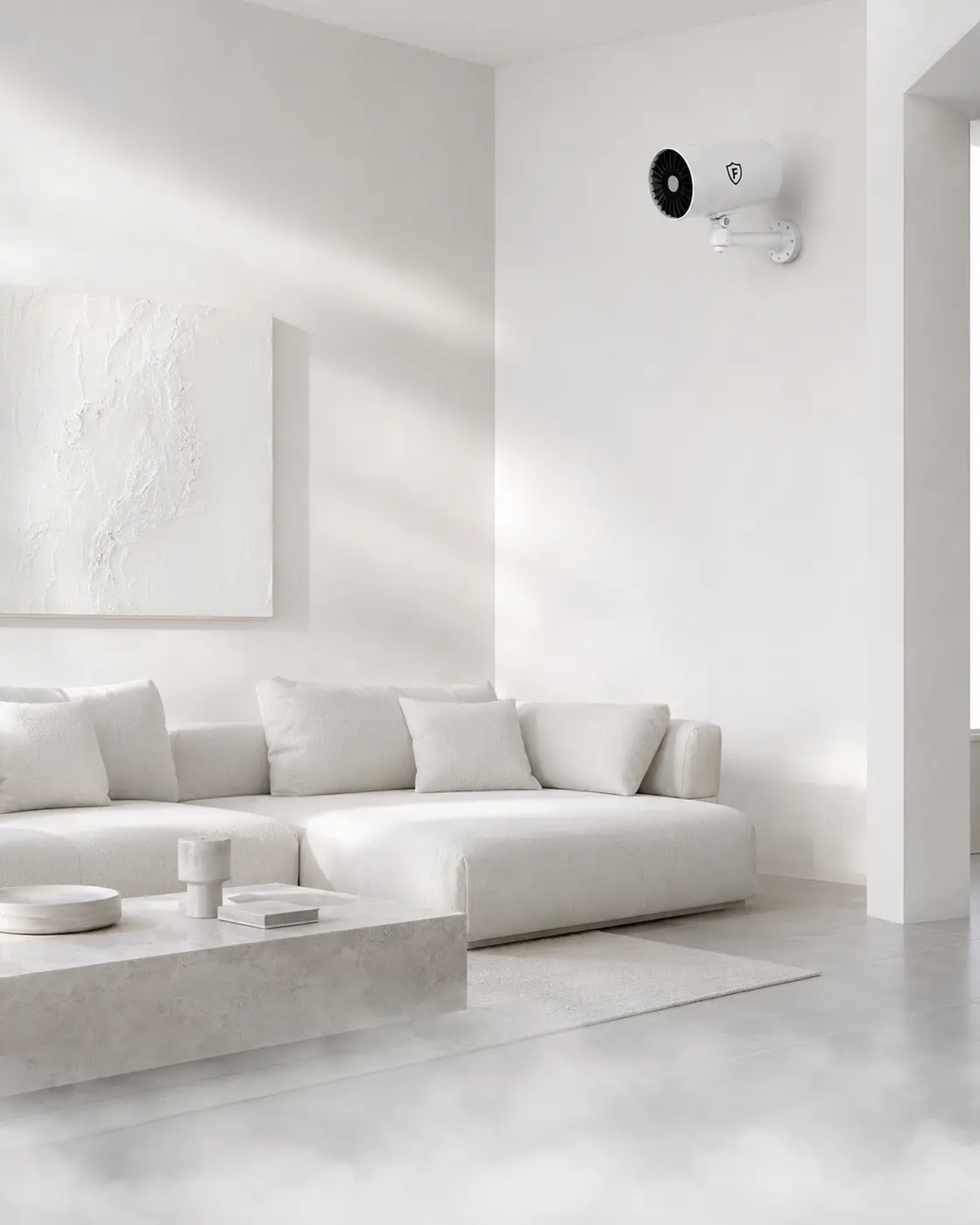
Yes, if you choose a self-install system. The Fogaway X1 mounts on a wall like a speaker, covers up to 60 square metres, and comes with its own siren, panic button, remote and app, so it protects the room the same day it arrives. Large certified commercial sites still suit professional installation.
Does security fog work with my existing alarm?
Usually yes. Most fog systems can take a trigger from an existing alarm panel as well as from their own sensors and remotes, so you keep the alarm you have and add the layer that physically stops the intruder.
What happens after a security fog system discharges?
The fog clears by itself, typically within the hour depending on ventilation, and leaves no residue to clean. You replace the used cartridge, rearm the system, and it is ready again. One discharge that ends one burglary usually pays for the system many times over.
Is security fog legal?
Security fog is legal and widely used in homes and businesses across Europe, the UK and the US. As with any security system, you should use fluid and equipment as the manufacturer directs and follow any local rules that apply to alarm systems in your area.
How is security fog different from a smoke machine at a party?
The principle is related, but security fog is engineered for speed, density and safety in occupied spaces: it discharges in under a second, fills a room to near-zero visibility, is dry rather than oily, and leaves no residue. A party smoke machine does none of that.
What is the single best first step if I can only do one thing this month?
Fix detection and response for the room where your most valuable things live. One protected room with a sensor, a siren and a fog device beats thin coverage everywhere, because burglars go where the value is, and that room is where a break-in actually becomes a loss.